Tuesday, April 20, 2021


                                     THE  DROUGHT


                Have we forgotten how it is to weep,

                And taught the very clouds to curb their rain?

                Have we anaesthetised all joy and pain

                And trapped creation in this arid sleep,

                Where dreams are mean and dry-eyed spectres creep

                With begging bowls?  If we could weep again,

                 Could care sufficiently to break the chain

                 That binds our hearts and offer what we keep

                 Imprisoned there, would earth recuperate

                 The mercy in our tears?  Would fields that slept

                 Awake;  would fruit and flowers proliferate

                 And streams make music from the sobs we kept

                 Held tight in burning throats?  Tears consecrate:

                 Christ looked upon Jerusalem and wept.


                                    *          *          * 


Saturday, February 13, 2021

A letter about London

 A thought struck me today.  May I share it with you?

For several years I've been writing these 'letters' from London.  The content of each 'letter' differs substantially from those that have gone before. London is the only constant.

But what struck me today was that this, too, has changed.  London is no longer the constant.  It, too, is in a state of total flux and none of us can foresee the outcome.

Shops that were open and flourishing a year ago are now, thanks to the pandemic, shuttered and empty.  Will they re-open one day?  For some, this is very much a matter of doubt.

Hotels, pubs and restaurants fall into the same category.  Will they have sufficient funds to re-open when the pandemic is over?  Will our local pubs operate once again as the centre of the community?  Who can tell.

Take the department stores in the West End, a feature of the area for centuries.  Will they be able to re-open now that so many of us are shopping online?  And, if not, what is to become of this large area of Central London?  Might the elegant buildings in Regent Street Oxford Street and Piccadilly be transformed into living accommodation, homes for the wealthy?

There is another factor.  Now that so many people are working from home, saving time and money previously spent on commuting, much office space will be standing empty.  Who will occupy these premises?  And what of the cafes in Central London, who provided refreshments and lunch for the office workers?  Will they, too, be driven into closure?

Neither you nor I can answer these questions.  The only certainty?  That we live in interesting times and that, like these 'letters', London will  never be the same again.


Wednesday, June 24, 2020

Under The Skin


                                                               Under The Skin

                                                                          *
 

                   Come, meet me in the dark with outstretched hands,
                   I would not know your colour or your kind;
                   And do not speak, in case my biased mind
                   Forms judgement long before it understands
                   The words you use.  Conceal from me the lands
                   You've travelled through, the culture that's entwined
                   In all your thoughts, the politics you find
                   Acceptable, the ground where your faith stands.
                   If I could come as nakedly as you,
                   Abandoning my way of life and creed,
                   Forgetting those ideas I'm closest to
                   And recognising what I really need;
                   Could we, for just a moment, see right through
                   Our diverse layers to our common seed? 


Thursday, April 2, 2020

Not all bad . . .

The coronavirus has brought grief, fear and economic breakdown.  It has also given rise to a sense of global uncertainty and impotence.

Nonetheless, may I, for a moment, put forward the argument that the situation is not all bad

Take climate change.
The almost total absence of aircraft in our skies, and the marked reduction of vehicles on the roads, has dramatically reduced the carbon emissions we are sending into the atmosphere.  Whilst Covid-19 may not have stopped climate change, it has certainly slowed down its formerly rapid progress towards ecological breakdown.

Take self-isolation.
This may be, and is, frustrating and limiting . . . but it has also produced innumerable acts of generosity and kindness.
It has brought communities together, and it has forced a society, which formerly never even paused between actions, to sit and reflect.

Self-isolation has caused us all to look out of our windows and ponder on what we can see . . . it has given us time to think.

When going out into our gardens, thanks to the absence of aircraft and traffic, we notice the birdsong.
Each day thousands of people are now joining the Facebook page of 'Rewilding Britain'. 
Why?  Because, for the first time in their lives, they're eager to identify the individual birds by their song.

And then there are the unexpected benefits.
All the homeless of London have been taken off the streets and housed and cared for in a large hotel.
Over half a million people have generously volunteered to help the NHS . . . whose selfless, dedicated work has been an inspiration to us all.
The coronavirus has brought the world together in unity of purpose.
Whilst, on a personal level, an opera singer, who is self-isolating in my apartment block, comes on her balcony each afternoon to lighten our day with an operatic aria.

And did you know that, if you visit the Kew Gardens' website, you can now take a tour of the gardens online?
Or that, despite its cancellation, the Chelsea Flower Show is planning a virtual show in May?

We are pausing, we are reflecting, we are learning.  We are discovering how,  as rapacious caterpillars, we ravaged the earth . . . we are considering the best way forward for the future.

And what will we be like when, humbled and thankful, we finally emerge  from our cocoons?

Let's hope we'll be transformed into butterflies . . . altruistic butterflies, ready to embark on a new life on a changed planet.

Monday, February 10, 2020

A Purr-fect Spot

Hello, it's Chloe again . . . have you a moment to spare?

I've been thinking about what I said to you last week, and I realised that there was something I'd forgotten to add . . . something very important.  In fact, I feel quite ashamed of myself for not having mentioned it.
So let me get my paws on the computer and put things right.


When my Mum adds something to one of her letters I've noticed that she calls it a PS.
What does PS mean?  I'm not really sure.         Let's call it a Purr-fect Spot to make things clear.

You'll remember that I'm a PAT Cat who works for the Pets As Therapy Charity . . .  I gave you examples of all the different things I do, and the interesting places that I'm lucky to visit.

But, oh dear me, what I forgot to mention was how much everyone really appreciates these visits . . .  and what this means to me and my Mum.


Just look at this photo . . . do you see the smile on the face of my good friend, Ian, at the nursing home?

Aren't I a lucky cat to be able to make someone smile like that.

And remember how I was asked to go to the Phobia Clinic to see Elijah, the small boy who was scared of cats?

Well, as I told you before, on that first visit he finally came into the room and stroked me, and everyone was so, so surprised and happy.

What you don't know is what happened when my Mum took me for a second time . . . shiver my whiskers if he didn't let me sit on his lap!

And how delighted they all were . . .Elijah, his Mum and the Clinic's doctor.

Yes, it's true, I'm a lucky cat . . . and a grateful cat.
And, let's be fair, I mustn't forget my Mum.  She means well and always does her best.

But I expect you can guess what it is that really makes me purr.

You can?  That's right!

It's when my Mum brings me home after our visits and my boyfriend, Blue,  comes down the steps from where he lives and welcomes me back to the garden.

That's a Purr-fect Spot to be if ever there was one!


Friday, January 10, 2020

Cat In Demand!

Hello, it's Chloe here . . . phew, do I need a good rest!  Writing to you will give me an opportunity to relax.

I can never remember such a busy start to the year, my paws have hardly touched the ground,  In fact, I think my most useful Christmas present was my new diary.

What's been going on?  Let me tell you.

As you'll remember, I work for the Pets As Therapy charity . . . and a very good charity it is.  They phone my Mum to tell her who's in need of my services, and she then acts as my chauffeur and takes me where I'm needed in our car.

Well, I've been visiting the patients at our local nursing home for years, and they're always very excited to see me, but last month my Mum had a very different request.

Did you know that some people are afraid of cats?  Yes, I know, I found it hard to believe myself.  But it seems these people have what's called a 'cat phobia' and cats simply terrify them.  The doctor from the local Phobia Clinic was in need of help for a small boy named Elijah and, well, you know me, I'm always ready to be helpful.  So off my Mum and I went to meet Elijah.

When we got to the Clinic he wouldn't even come into the room, he just peered at me through a window, looking really scared.  I don't want to sound boastful, I'm not a boastful cat, but by the time we left he was actually patting me on the head and wanted to know if I could visit him at Christmas.  The Clinic is so pleased with my visit that it's booked me to go back twice this month . . . two more dates for my new diary.

Then, shiver my whiskers if there wasn't yet another call on my services . . . quite a different kind of request this time.  It seems that a local church has acquired a family of mice.  Speaking for myself, I can't see why the mice shouldn't be there.  After all, they're all part of God's creation.  But the vicar wanted me to walk around inside the church so that my scent would discourage these mice from staying.

I was perfectly happy to oblige, and, as you can see, had a very interesting time exploring the church.  Although I must say that I'm rather surprised the mice should have wanted to live there in the first place, it didn't feel very cosy to me.

So, there you have it. 

Can you see why I'm in need of a rest?

Believe you me, it's a demanding world if you're a co-operative cat . . . you human beings need such a lot of help. 

What a relief that, when each visit is over, I can come home, go into the garden, and share my thoughts with my good friend Blue.

Thank heaven for understanding cats!

My good friend Blue and me!

Tuesday, October 1, 2019

Waitiing in the Wings

I've recently been watching a video which gave me pause for thought.
May I share some of these thoughts with you?

As I see it, the world is in need of imaginal cells.
What do I mean?  Let me explain.
Imaginal cells are the cells inside the caterpillar which emerge in the larval stage and slowly unite to form the butterfly.  As the caterpillar's other cells disintegrate, so these new cells gain strength.

Ultimately, a previously hungry, destructive, earthbound life-form is changed from within to become an air-bound creature of delicacy and beauty.


I wonder, did something else come to mind as you read that description?
Wouldn't you agree that, at this point in time, our world is caught up in a similar state of confusion and self-destruction . . .  and that we, too, are desperately in need of imaginal cells to bring about a similar transformation?

We won't dwell on the confusion and antagonism that is surging around at the moment . . . let's look instead for the possible existence of those life-changing cells.

First of all, surely they can be found in all activists for climate change, and in every effort being made to conserve the environment, and to show love and respect for our fellow creatures?  Only this week, an imaginal cell was activated in Oxford.  The principal of St. Edmund Hall, Prof. Katherine Willis, made the inspired decision to coat the walls and terraces of the college with flowers, plant life and shrubbery.  What a pleasure for every passer-by . . . what a benefit to the Oxford environment.

And that wasn't all this week.  It's only a matter of days since the Girl Guides in the UK made a pledge to tackle plastic pollution.

Imaginal cells are found in trust, compassion and understanding.  They thrive on happiness and love, and shine the light of positivity into the darkness of negativity.

It would seem that we have a choice to make . . . are we to be part of the disintegrating and self-destructive caterpillar, or imaginal cells with our sights set on future transformation?

Is there a butterfly waiting in the wings . . . ?

We can only hope.

To watch the two-minute video I mentioned at the beginning,  click here  . . and enjoy!

Monday, August 19, 2019

What can we do?

At a time when we're all badly in need of good news, I apologise for drawing your attention to a powerful video that's far from encouraging.
It lasts for little more than one minute, but it packs some hard punches.

And the subject it covers?
Yes, you've guessed . . . it's plastic.

As we learned last week, micro-plastic particles have somehow managed to spread to the remote, snowy wastes of the Arctic.  Plastic, it seems, has permeated every corner of our planet.

How did it achieve such a feat?  To give you one alarming example, whenever plastics are dumped in landfills, the hazardous chemicals seep underground when it rains, infiltrating into the aquifers and water table and indirectly affecting groundwater quality.  It's a sobering thought.

And that isn't all.   Did you know, at this moment, you and I are inhaling particles of plastic?
Recent comprehensive tests, undertaken in both urban and rural areas, have shown conclusively that plastic particles are to be found in the atmosphere.  What's more, they're now known to have infiltrated the food we eat.

And things get worse.  Plastic, which was originally made from cellulose found in plants and trees, is now almost entirely made from oil, natural gas, coal and minerals.
It could well be said that, in excavating for the source of plastic, we are making a major contribution to climate change.


However, it's a complex situation because there are other important factors.
Did you know that here, in the UK, we produce over one and a half million tonnes of plastic raw materials annually?
Not only that, with the UK's plastic processors consuming over three million tonnes, the UK is one of the five top processors of plastic in the EU.

I'm typing this letter to you on a plastic keyboard,  I've just been speaking on my plastic telephone . . . plastic is big business.

Yet, whilst accepting that plastic is now an inevitable component of modern life, with a factor to play in our economy, surely we should be attempting to remove the large percentage of unwanted plastic that our thoughtlessness has allowed to escape into the environment?

If, as it would appear, we are all of us breathing, eating and drinking invisible particles of plastic on a daily basis, isn't it time to take action?
Surely we should be doing everything we can to extract it from the air, the water and the soil?

With which thought in mind, let's return to the video I mentioned at the start of this letter.
I'm sure you'll agree that it needs to be seen, it needs to trigger our anxieties and activate our future actions . . . so, please click here.

LATER
Thank you so much, Marion, for your immediate response, and for telling me of the tiny nation which is waging war on plastic - there's still room for hope.
Let me share this encouraging development . . .  click here.

Sunday, August 4, 2019

For want of a lead!

Hello, it's Chloe here . . . may I share some thoughts that have been niggling me . . . thoughts about the ups and downs of having a boyfriend?


As I've discovered with Blue, having a boyfriend in your life is a very good thing.  I'd be the last cat to argue about that.
It makes your ears prick and your whiskers quiver with excitement . . . oh no,  I certainly wouldn't want to go back to being on my own.

But, for all that, I must admit that boyfriends also present problems.


Now, unlike Blue, I'm very lucky to have a harness and lead . . . and a co-operative Mum on the other end.
Thanks to my lead, I have a very full life outside the garden.

I travel in my Mum's car . . .  we go visiting . . . my Mum takes me for walks in the country . . . I get out and about and thoroughly enjoy myself.

When I'm with Blue in the garden we play.  We have great games together . . . and can sometimes end up feeling quite exhausted.

But Blue is convinced that it's my lead that enables me to go through the garden gate and do exciting things in the world outside.

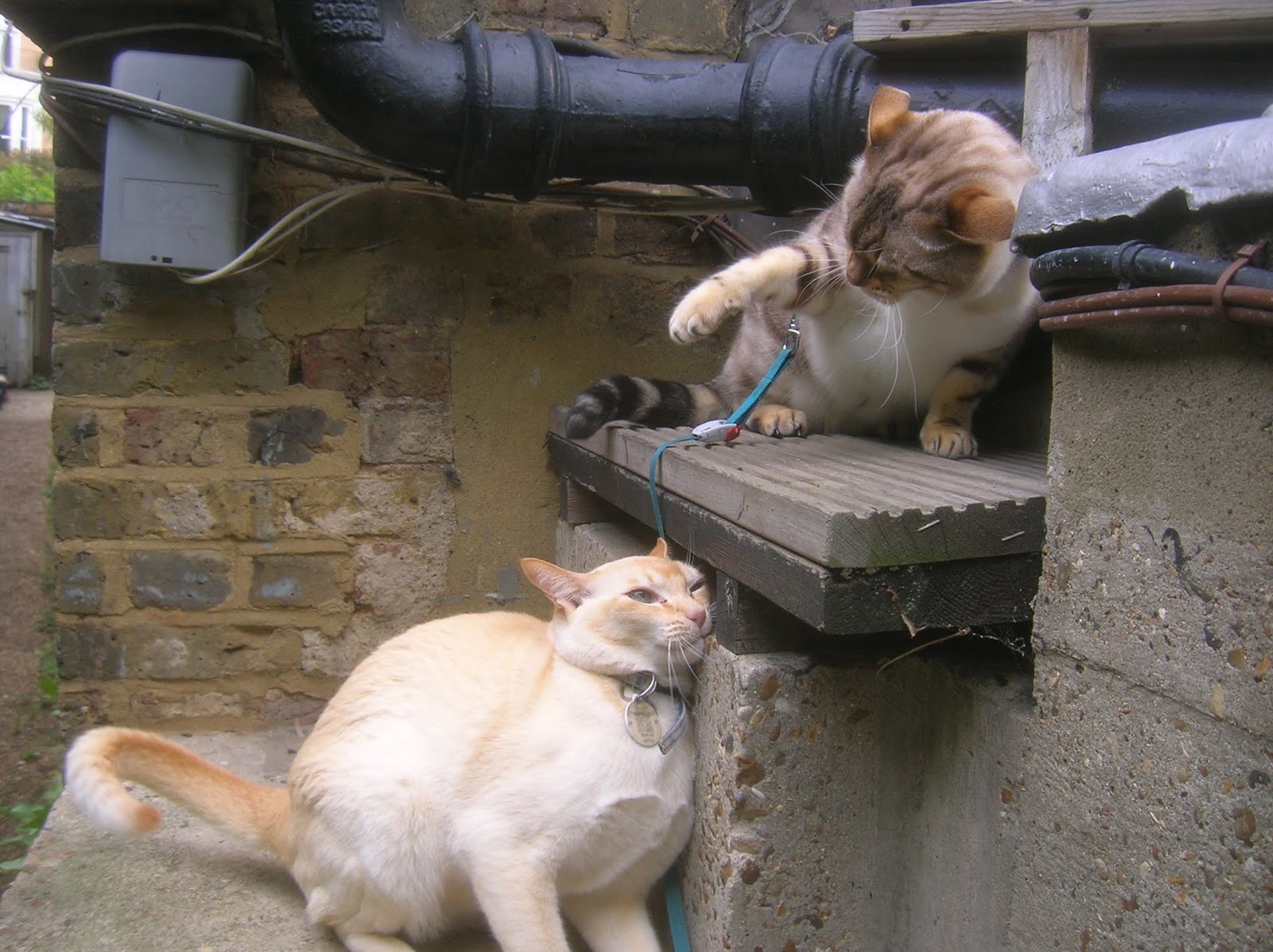
And, as you'll see in this picture, he wants the lead for himself.
He does his very best to grab it so that he, too, can go outside the garden gate.

But, just between you and me, I'm not at all certain that this would be a good idea.

Wouldn't you agree that there's something rather special about being the only cat in the company of a lot of highly respectful and helpful humans?

Would it be the same if Blue was there as well?
No, I'm not at all sure that it would.

True, I love to sniff noses and play with Blue in the garden. 

But, when it comes to being appreciated by a crowd of humans at a pub lunch . . . being admired on a country walk . . . or bringing pleasure to the patients at the nursing home  . . . well, and don't tell Blue I said this, there's a lot to be said for being a celebrity cat on your own!

Thank you so much for sharing these thoughts.  You've helped me make up my mind that, although it's great to have a boyfriend, they're best kept for games in the garden . . . and without leads!

Wednesday, July 10, 2019

Action needed now

I wonder if you  heard the sobering news that came out of Alaska last week?

For the first time since records began, the temperature in this US state, part of which lies inside the Arctic Circle, rose to ninety degrees Fahrenheit.
When one takes into account the fact that, at this time of the year, the normal temperature in Alaska is around fifty degrees, that is a mind-boggling increase.

The outcome?
Not only is the ice melting on an unprecedented scale, but the state's economy is suffering accordingly.
In addition, thousands of puffins are dying . . . the fish they need for sustenance are moving further north to avoid the warming seas.

But Alaska isn't alone, let's switch our attention to Greenland.  Here the story is equally serious.

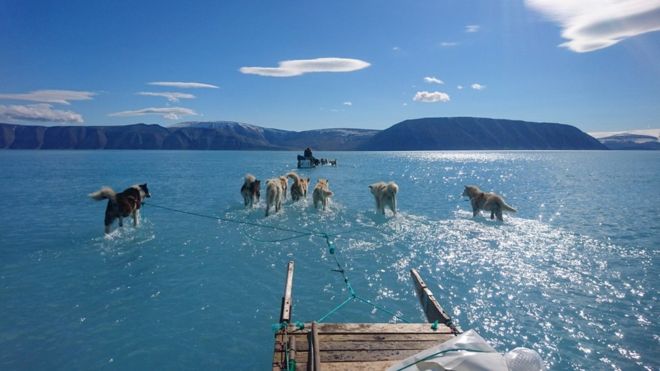
It's hard to accept that the huskies in this picture are paddling through water that, until quite recently, comprised a firm surface of frozen snow . . . climate change has reduced the surface area to water.

Wouldn't you agree that we are, in effect, on board 'The Titanic', fast approaching the iceberg of climate destruction.   However, instead of concentrating on the approaching iceberg, we're most of us fixated on our current political chaos.
When some new climate revelation hits the headlines, we briefly register shock.  But, all too quickly, this is pushed into the background and our attention goes elsewhere.

"We shouldn't be talking about 'climate change', it's a 'climate crisis'," declared the UN Secretary General's representative recently.  "This isn't about the future," she insisted, "this is about today, adaptation and resilience are urgently needed now."

True, in this country, although the temperatures are rising, we're not faced with the prospect of losing our homes to rising water levels, as are the inhabitants of Bangladesh.

However, as the waters rise around the planet, so the amount of habitable land is shrinking and the world's population is growing.

What's more, the turbulent weather is worldwide, only this week fatal floods hit northern Spain  . . .  we are all in this together.

So, let's follow the guidance of the young people, and take the UN's advice to heart.
As Sir David Attenborough told MPs in the House of Commons yesterday, the climate crisis must be at the forefront of every consideration, making it the key motivation in all we do . . . reducing our carbon emissions, eating less meat, making fewer journeys, and, above all, treating our irreplaceable planet with the care and respect it deserves.
Time isn't on our side.

May I leave you with the thoughts conjured up by a very sobering video from the southern hemisphere.  Click here to see just what it is that we've activated . . . and let it inspire you to do something about it.


Wednesday, June 19, 2019

In the palm of my paw!


Hello, it's Chloe here. . . my Mum has just gone out, so may I up-date you on my relationship with my boyfriend, Blue?
I'll be as quick as I can before my Mum gets back.

Well, between you and me, what I'm learning fast is that there's a lot more to this girlfriend/boyfriend business than I originally thought
. . . much, much more!

It's not just a simple question of kissing noses and sitting together on the garden seat . . . oh no, far from it!

True, we do kiss noses when we meet, and that's nice . . . there's nothing like a loving kiss to put a quiver in your whiskers.

But, if he wants to continue kissing when we jump up  together on the seat, well . . .  no girl wants her kisses to be taken for granted, and I tell him so!

A playful biff on the nose gets my message home loud and clear!

As well as playing together, something we both enjoy, I encourage him to come with me and my Mum when we explore the garden.

We find all sorts of unexpected things, and you'll never guess what we came across the other day.
My Mum says it's a lion, and I suppose she knows what she's talking about.  But I must say it took me by surprise!

If lions can stare, I said to myself, then I can stare too!
Mind you, I think Blue was a little worried, he thought I'd found a new boyfriend!

Every morning, when my Mum and I go into the garden after breakfast, Blue is waiting for us by the garden gate.


I'm really very fond of him, and I know that I'd miss him terribly if he wasn't there.


Nonetheless, there's no doubt that a boyfriend needs to be told who's in charge . . . and, as a good girlfriend should, I always try to do just that!

Wouldn't you agree that I've got him firmly in the palm of my paw?
Let's hope so!


Thursday, June 6, 2019

Anything we can do . . .

"Anything  you can do, I can do better.  I can do anything better than you."
So wrote Irving Berlin in his well-known song.

It's an attitude that we humans have adopted in relation to all other life on the planet.  In our eyes, we can do better than anything else.

But have we, I wonder, been very, very wrong?

If you happened to read the January issue of"The National Geographic Magazine", or watched "Springwatch" last week, you'll have been as surprised as I was to learn that plants can 'hear' bees buzzing.
Not only that, they can distinguish the buzzing of a bee from the buzzing of a fly, and respond accordingly.

In a recent experiment, scientists found that, when a bee flies near to a flower, the plant will produce  a sudden burst of extra sugar to entice the bee to alight and pollinate.  The buzzing of a fly, or any other similar vibration, fails to produce the same response.

And did you know that trees communicate with each other below ground level?
The forester, Peter Wholleben, tells us that trees work actively to keep every member of their community alive.  The key, it seems, lies in the so-called Wood Wide Web.

He writes of fungal networks that link the trees' roots and form a wide-ranging network of communication.        Trees, it seems, nurture their saplings, curb the aggressive, and generally keep their community strong.
Trees care for each other.

Click here to watch a fascinating video which demonstrates exactly how the Wood Wide Web operates.

Another surprising fact that's come to light recently relates to moths.  Despite going through the biological meltdown that turns them to 'soup' in their larval stage, scientific tests have shown that moths have clear memories of the environment they experienced as caterpillars.
 A moth with memories?  It's an intriguing thought!


However,  did you know that, thanks to our destructive interference, the insect population is at crisis point?  Seventy per cent of the UK's insects have disappeared in the last twenty years.
What's more, we've destroyed a tenth of Earth's wilderness since the turn of the century.
We've a lot to answer for.

But let's return to the song that started our discourse.
Let's acknowledge the fact that life on Earth isn't a question of competition . . . of doing better, of being better.  This is where we've got it so very wrong.
Every species on this planet is part of the whole . . . an inter-connected, integrated whole.  Each has its own vital and intelligent part to play.

Mightn't we be wise to show a little humility?
Shouldn't we think, as we hurry heedlessly along, of the silent but active fungal communication taking place beneath our feet?
Shouldn't we pause to watch in wonder as the bees answer the summons of the nectar-laden flowers?
Are we totally forgetting that the oxygen produced by trees, and the food germinated by insects, are vital to our survival?

After all, when it comes to the crunch, it's we who need the natural world, it hasn't the slightest need of us. 
No scientist would disagree with that proven fact . . .  but surely, if we're to survive, it's one we should take very seriously?

Wednesday, May 8, 2019

A breaking bough


Perhaps the most unexpected outcome of the recent fire at Notre Dame was not what was lost, but what was saved.

The majority of the irreplaceable treasures inside the building were taken to safety.  The altar and the choir stalls survived.  The stonework and most of the glorious, stained-glass windows remained intact.

But which of the survivors of the fire were ultimately of the greatest value to the world at large?
Surely it must be the two hundred thousand honey bees who were housed on the roof.  Initially, the bees were thought to have died, but the carbon dioxide from the fire put them to sleep.  They were later discovered, intoxicated but alive, safely housed inside their hives.

There's no denying that Notre Dame is both awe-inspiring and truly magnificent.  But, much as we would miss such fine, historic buildings, ultimately we could exist without them.

However, as Albert Einstein declared, "If the bee disappears from the surface of the earth, man would have no more than four years to live."

As in Paris, here in London we are also supporting bees.
This week, a seven-mile long 'bee corridor' is being planted in Brent in an effort to boost the number of pollinating insects.

But, worldwide, there is little good news on this front.  Our indiscriminate use of pesticides has caused the insect population to go into sharp decline.

Nor are they alone.   I'm sure you've read details of the very sobering, UN-backed report that was published the other day.  It didn't pull its punches.

Over a million species, it states, are currently threatened with extinction.  The world's biodiversity is fast vanishing, and one in four species is at risk of disappearing.  This includes forty-three per cent of amphibians, twenty-five per cent of mammals, thirty-four per cent of conifers, twenty-two per cent of coral reefs, and fourteen per cent of birds.

Tell me, when did you last hear a skylark  . . .  or a cuckoo?

And the reason for this dire situation?
Yes, you're quite right.  As with the the current climate crisis, human activity is largely to blame.
Habitat degradation, thoughtless exploitation, deforestation and plastic pollution lie at the heart of the problem.

We are, in effect, sawing through the branch we are sitting on . . . and it won't offer us security for much longer.

Have we arrived at this realisation too late?  Who knows.  With many world leaders denying climate change, with mass felling of the remaining rain forests, and our UK politicians preoccupied with Brexit, it would seem that there's little or no hope of a positive political initiative.

However,  the people at large may be waking up and experiencing a change in perspective.

Not only are we losing patience with our political leaders, but, more importantly, we are becoming aware of wider issues.

For centuries we've put our economic needs at the top of our agenda.  Albeit belatedly, we're now realising the need to bring the intrinsic value of nature into our economic thinking.

For centuries we've considered the human race to be separate and superior to all other species.
At this eleventh hour, could it be dawning on us that we're but a fragment of an united and inter-dependent whole?

And this is where, as I'm sure you've noticed, two people have stepped into the limelight.  Two people who strongly believe in our ability to wake up and change . . . one of whom is old and experienced, the other young and passionate.

No-one has done more to draw our attention to the critical situation of life on the planet than the veteran naturalist and broadcaster, David Attenborough.

Whilst the Swedish teenager, Greta Thunberg, prompts young people worldwide to take action, motivates the Extinction Rebellion movement, and succeeds in rallying politicians to her cause.

So, with David Attenborough to instruct and guide us, Greta Thunberg to inspire us, and the bees of Notre Dame and Brent to give us hope . . . we may not deserve it, but surely there's still time to strengthen our fragile branch before it breaks?
And, if you want to petition Parliament for support, then why not click here.